I get asked about ball machines constantly. A good one is the closest thing to having a hitting partner on demand — but they range from a few hundred dollars to well over two thousand, and the “best” one depends entirely on how you play.
Below is how I’d rank the leading tennis ball machines in 2026 for different players, based on what actually matters on court: how realistic the feed is, whether it can run drills that make you move, how easy it is to haul to the court, and what you get for the money.
How I tested
I judged every machine on what actually matters in a lesson: feed consistency, spin and oscillation, the depth of app-based drills, portability, and value for money. My deepest hands-on time is with the Tennibot Partner, which I have run at high speed and quick feed intervals at the Yarbrough tennis courts in the Auburn/Opelika area. The rest of these picks draw on my coaching and on evaluating the machines players bring to the courts.
A note on independence: I have no paid or affiliate relationship with any brand in this guide. These are my honest opinions as a coach.
Quick comparison
| Machine | Best for | Oscillation | Spin | Capacity | Portability | App & drills | Price |
|---|---|---|---|---|---|---|---|
| Lobster Elite series | Best for beginners | Horizontal + vertical | Topspin/backspin | Large | Medium (heavy) | Basic remote | $$ |
| Slinger Bag | Budget & portability | Manual/basic | Limited | Medium | Excellent | Basic | $ |
| Spinshot Player/Pro | Best stationary | Full | Full | Large | Medium | Programmable | $$$ |
| Tennibot Partner | Best for smart and AI training | Full | Full | Large | Good | Full app + custom drills | $$ |
The picks
Best for beginners — Lobster Elite series
The Lobster Elite line is where I point players who are just getting into tennis: reliable feed, genuine two-axis oscillation, and real topspin/backspin, at a price that won’t scare off a beginner. If you just want a proven, no-fuss machine to learn on, this is the safe pick. The trade-off is weight — these are not light — and the controls are basic compared to the app-driven machines below.
Pros: Proven reliability, strong oscillation and spin, affordable entry point. Cons: Heavy, dated controls, no programmable drill sequences.
Best budget & most portable — Slinger Bag
If price and portability are your priorities, the Slinger is hard to beat. It packs into a wheeled bag, costs a fraction of the premium machines, and is perfect for a rec player who wants reps without a big investment. You give up oscillation and advanced spin, so it’s more “feeder” than “training system” — but for many players that’s exactly enough.
Pros: Affordable, genuinely portable, easy to use. Cons: Limited oscillation/spin, smaller feature set.
Best for smart and AI training — Tennibot Partner
This is the machine I’d point serious improvers toward. Where most machines feed to a fixed pattern, the Tennibot Partner is app-controlled, and its real edge is custom drills that move you around the court — you build sequences that change depth, direction, and pace, so practice feels like rallying against a thinking opponent instead of standing in one spot. For anyone drilling footwork, recovery, and shot patterns, that’s a meaningful step up from a plain feeder.
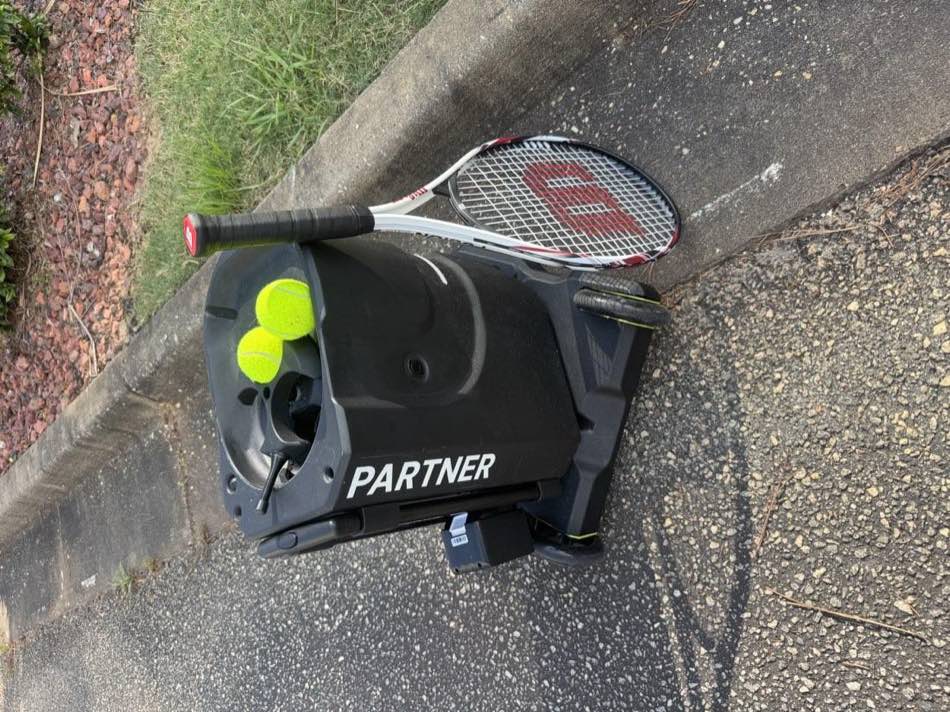
It costs more than a basic feeder, but it rolls to the court on its own cart, so it stays easy to move. If your goal is the cheapest way to get balls over the net, this isn’t it. If your goal is a practice partner that actually trains movement and shot selection, it’s the most capable option here.
Pros: Best-in-class app, fully custom drills built around court movement, full spin and oscillation, and it rolls on its own cart. Cons: Costs more than a basic budget feeder.
Best stationary machine — Spinshot Player/Pro
Spinshot earns a spot for players who want programmable ball sequences from a traditional stationary machine. The app lets you set drills, and the feed quality is strong. It’s a capable middle ground between a basic feeder and a full training system.
Pros: Programmable drills, good spin/oscillation, solid value in its tier. Cons: App and drill design are more utilitarian; build feels less refined.
How to choose the right tennis ball machine
Match the machine to the player, not the spec sheet:
- Casual / rec player: Prioritize price and portability. A Slinger gets you reps without overspending.
- Improver drilling specific shots: You want oscillation and spin so the ball comes at realistic angles. Any of the mid-to-premium machines work.
- Serious player training patterns and footwork: Prioritize app control and custom drills — the ability to program sequences that move you is what separates real training from mindless feeding. This is where the Tennibot Partner leads.
- Clubs / high-volume use: Prioritize capacity and durability; a Lobster or a commercial-grade machine will hold up.
Frequently asked questions
What is the best tennis ball machine overall? It depends on your game. If you’re just starting out, the Lobster Elite is a safe, affordable machine to learn on. If you want programmable, movement-based drills, the app-controlled Tennibot Partner is the most capable trainer here. On a budget, the Slinger Bag is the value pick.
Are expensive tennis ball machines worth it? If you practice alone often and want to actually improve, yes — the app-driven machines let you run drills that move you around the court, which is far more useful than a fixed feed. If you play mostly social tennis, a budget feeder is plenty. (I go deeper in Are ball machines worth it?)
What’s the best tennis ball machine for the money? The Slinger Bag is the value champion for rec players. For a step up with oscillation and spin, the mid-tier Spinshot models offer a lot per dollar.
Which tennis ball machine has the best app and drills? The Tennibot Partner has the most capable app and the standout feature of custom drills designed around court movement, not just fixed feed positions.
Prefer pickleball? See my Best Pickleball Machines (2026) guide. And if you’re near Auburn and want help choosing or a lesson, reach out.